
Dance Pointe Acrobat Competition Team Martial Arts Summer Dance Camp
Our dance year begins in September after Labor Day and ends with Recital performances held in June. Registration is held during August and classes are closed November 1st.
The studio observes the student holidays and days of no instruction listed on the GCCISD calendar.
- We have several parties throughout the year celebrating Halloween, Christmas, Valentine’s, and Spring.
- Students are not required to participate in the parade or the studio parties.
Ballet, Tap, Jazz classes
For ages 3 to adult.
Classes are assigned at the time of registration by age/grade and skill level.
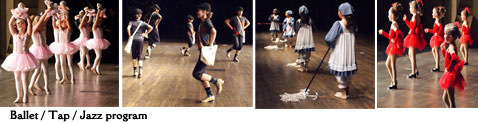
Ballet is a type of performance dance that originated in the Italian Renaissance courts of the 15th century and later developed into a concert dance form in France and Russia. It has since become a widespread, highly technical form of dance with its own vocabulary based on French terminology. It has been globally influential and has defined the foundational techniques used in many other dance genres.
Ballet requires years of training to learn and master, and much practice to retain proficiency. It has been taught in ballet schools around the world, which have historically used their own cultures to evolve the art.
Tap dance is a form of dance characterized by using the sound of one's tap shoes hitting the floor (or other surfaces) as a percussive instrument. As such, it is also commonly considered to be a form of music.
Two major variations on tap dance exist: rhythm (Jazz) tap and musical theatre tap. The sound is made by shoes with a metal "tap" on the heel and toe. Tap shoes can be bought at most dance shops. There are different brands of shoes which sometimes differ in the way they sound.
Jazz dance is a classification shared by a broad range of dance styles. Before the 1950s, jazz dance referred to dance styles that originated from African American vernacular dance. In the 1950s, a new genre of jazz dance — modern jazz dance — emerged, with roots in Caribbean traditional dance. Every individual style of jazz dance has roots traceable to one of these two distinct origins. Jazz was a big hit in the early 50's and it is still a well loved style of dance all over the world. Moves Used In Jazz Dance include Jazz Hands, Kicks, Leaps, Sideways Shuffling, Rolled Shoulders, and Turned Knees.
Pointe classes
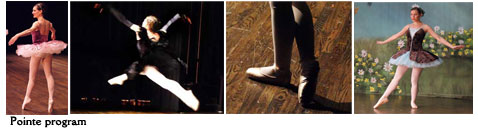
Pointe technique is the part of classical ballet technique that concerns pointe work, in which a ballet dancer supports all body weight on the tips of fully extended feet. A dancer is said to be en pointe when the dancer's body is supported in this manner, and a fully extended vertical foot is said to be en pointe when touching the floor, even when not bearing weight.
Pointe work is performed while wearing pointe shoes, which employ structural reinforcing to distribute the dancer's weight load throughout the foot, thus reducing the load on the toes enough to enable the dancer to support all body weight on fully vertical feet.
Pointe technique resulted from a desire for female dancers to appear weightless and sylph-like. Although both men and women are capable of pointe work, it is most often performed by women. Typically, years of training and practice are required to develop the strength and technique needed to perform pointe work.
Pointe and beginning pointe classes are available to students with prior ballet experience who are currently enrolled in regular dance classes at our studio.
Acrobat classes
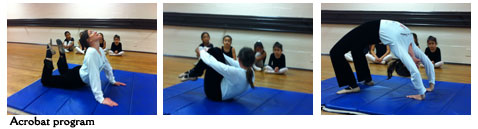
Acrobatics (from Greek - akrobateō, "walk on tiptoe, strut") is the performance of extraordinary feats of balance, agility, and motor coordination. It can be found in many of the performing arts as well as in many sports (sporting) events, and martial arts. Acrobatics is most often associated with activities that make extensive use of gymnastic elements, such as acro dance, circus, and gymnastics, but many other athletic activities — such as ballet and diving — may also employ acrobatics. Although acrobatics is most commonly associated with human body performance, it may also apply to other types of performance, such as aerobatics.
Acrobat for dance and performance classes are available to students currently enrolled in regular dance classes at our studio. Registration is open at the studio desk.

Martial Arts for all ages:
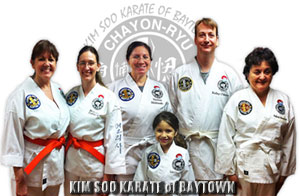
Cheryl's Dance Studio presents Chayon-Ryu "Natural Way" Martial Arts for health, success and longevity. Founded in 1968 by Korean Grandmaster Kim Pyung-Soo, the first Chayon-Ryu school in the Baytown area was opened in 1970. We are proud to host a Kim Soo Karate campus in our facility. Learn classical martial arts in a comprehensive traditional system
including Tae Kwon Do, Karate,
Chuan Fa, Judo/Jujitsu, and Hapkido/Aikido.
White-black belt program accepts students beginning at age 6.
Kid Tigers program accepts students age 3-5.
We offer specialized seminars and workshops on self-defense.Chayon-Ryu, is for everyone--families, kids, teens, adults, Seniors.
Kyosanim Melissa L. Nichols, Chief Instructor
Kyosanim Melissa Dabney, Instructor
More information on the martial arts program can be found on the KIM SOO KARATE of BAYTOWN website. Registration is currently open.
 Summer dance camps are usually held in July. If you would like to receive information about our camps, please fill out the form for theregistration mailing list.